
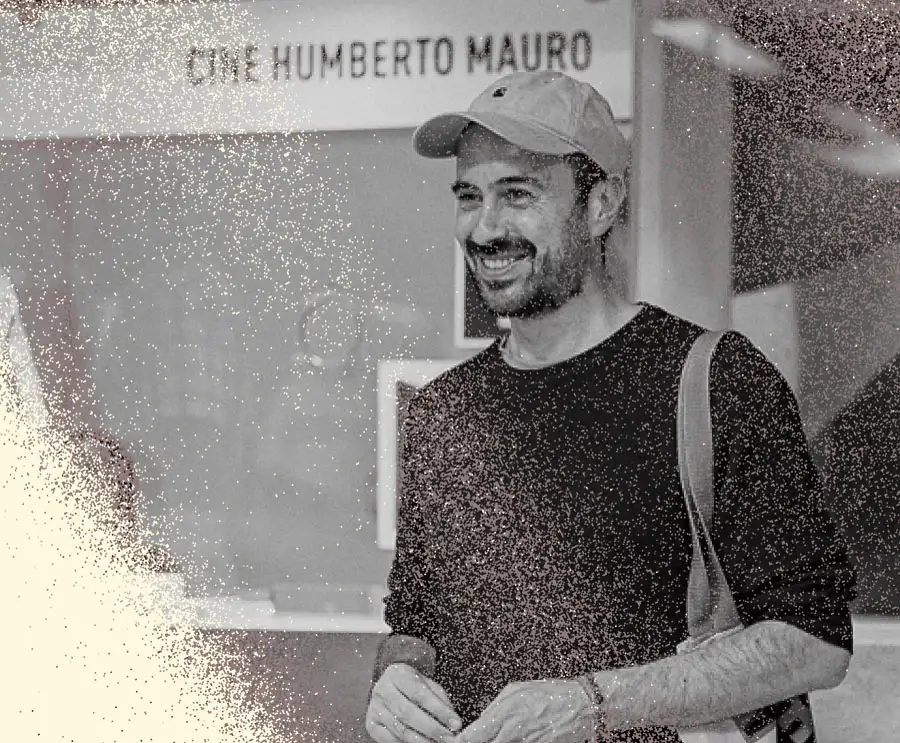
Spanish filmmaker, who screened his film “Stone Shadows” in the International Competition program, was present at the 27th FestCurtasBH. Read the interview he gave to curator Juliana Gusman.
Pasolini filmed the “unreal perfection” of the walls of Sana’a, the capital of Yemen, in the early 1970s, an appeal to the “scandalous revolutionary force of the past” embedded in its pre-capitalist architecture. The landscape, which allows us to glimpse other common horizons, was, at that time, obscured by a diminished idea of progress that, in some way, minimally suppressed. After all, when the Spanish multidisciplinary artist Sebastian Paramio arrived in these lands, almost five decades later, it was still possible to glimpse utopias. From these wraiths and mourning emerges his first film, Stone Shadows, one of the 18 works selected for the International Competition of the 27th FestCurtasBH. We had a brief conversation about the film:
Juliana Gusman: I wanted to ask you about the creative process behind Stone Shadows, one of the films in the International Competition, which weaves together various elements: photographs, images from other films, a passion for Pasolini, a narration-letter to your brother. How does it all come together?
Sebastian Paramio: As I said in the discussion after the screening, this film arose largely from intuition. The stories emerged in a somewhat unconscious way, I would say. My first impulse was to talk about Yemen, about the time I lived there, which was very special. It’s a non-Westernized place, different from the world we live in, and that interested me. And then came the discovery of Pasolini. I understood that his vision of Yemen resembled mine, of a displacement from the Western world. And finally, there was the issue of my brother’s disappearance. The initial narrative, which would have focused on that territory, then became a need to talk to my brother and tell him about that experience, and also about what it meant to have had him in my life. It was a stitching that somehow woven itself, a stitching that was also healing. Making the film heals me in various senses.
J.G.: And how did you perceive the dialogue between your film and the other three that composed the first program of the Festival Competitive Section? Manal Issa, 2024 (Elizabeth Subrin, USA, 2024), Daria’s Night Flowers (Maryan Tafaroky, Iran, UK, France, 2025) and The Flowers Remain Silent, Witnessing (Theo Panagopoulos, Palestine, UK, Scotland, 2024).
S.P.: I really liked the combination of films, firstly for an obvious reason: they all deal with the Middle East. But there’s something even more important, which is seeing the other from the West. From here, we are unable to look, to give a face to these people. They don’t appear in the news: only bombs, wars, and tragedies are made visible. But what are their lives like? Who are these people? I believe that, precisely at this moment, what we need to do is to see otherness and understand that we could be in their place. The Mediterranean tradition tells us that the Muslim world and the Arab world are also part of Europe. It’s important to understand that we are also them.
J.G.: It’s interesting to hear you talk about the need to blur these boundaries between the self and the other, since this year the main theme of FestCurtas is the “spell-film,” not as an obvious representation of a naive idea of magic, but as gestures that bet on the re-enchantment of the world: movements to reunite and re-establish what capitalism has historically divided. We’re talking about crossing boundaries between the human and the non-human, between violently separated groups that, in fact, need each other to survive. I think about how your film also conjures a personal re-enchantment, because it deals with reunions and renegotiations after some displacements, whether geographical, affective, caused by travel or loss. Do you perceive this idea of enchantment hovering over your film?
S.P.: Yes. My culture, which is Spanish, is also Muslim. I think these divisions between Europe, Africa, or the Arab world are artificial divisions, and art is what allows us to infiltrate the fissures of these borders. We are all part of the same identity.
J.G.: And how has the journey, the trajectory of Stone Shadows, been going?
S.P.: I like how films, like works of art, become independent of their author. I like to talk about the film as something that is increasingly distant from me. It’s making its own way. It received the Best Film award at the Beijing Short Film Festival, and an editing award at the Aguilar del Campoo Festival – Castilla y León, in Spain. It has also been shown in other countries, England, Italy…being selected to be in those places is already an award. I feel it’s a film that reaches people. It seems very special to me that someone from Brazil or China can feel this connection.
J.G.: And how has the experience of attending the festival in person, in Belo Horizonte, been?
S.P.: I was very surprised by everything. I was surprised to learn that this is a festival with 27 editions; it’s already a cultural tradition. And it’s my first time in Belo Horizonte, and one thing I notice in Brazil is that I feel this is a country where diversity is present. A place where you feel an energy of change, of searching, and of the future. I believe the festival is a good reflection of that.